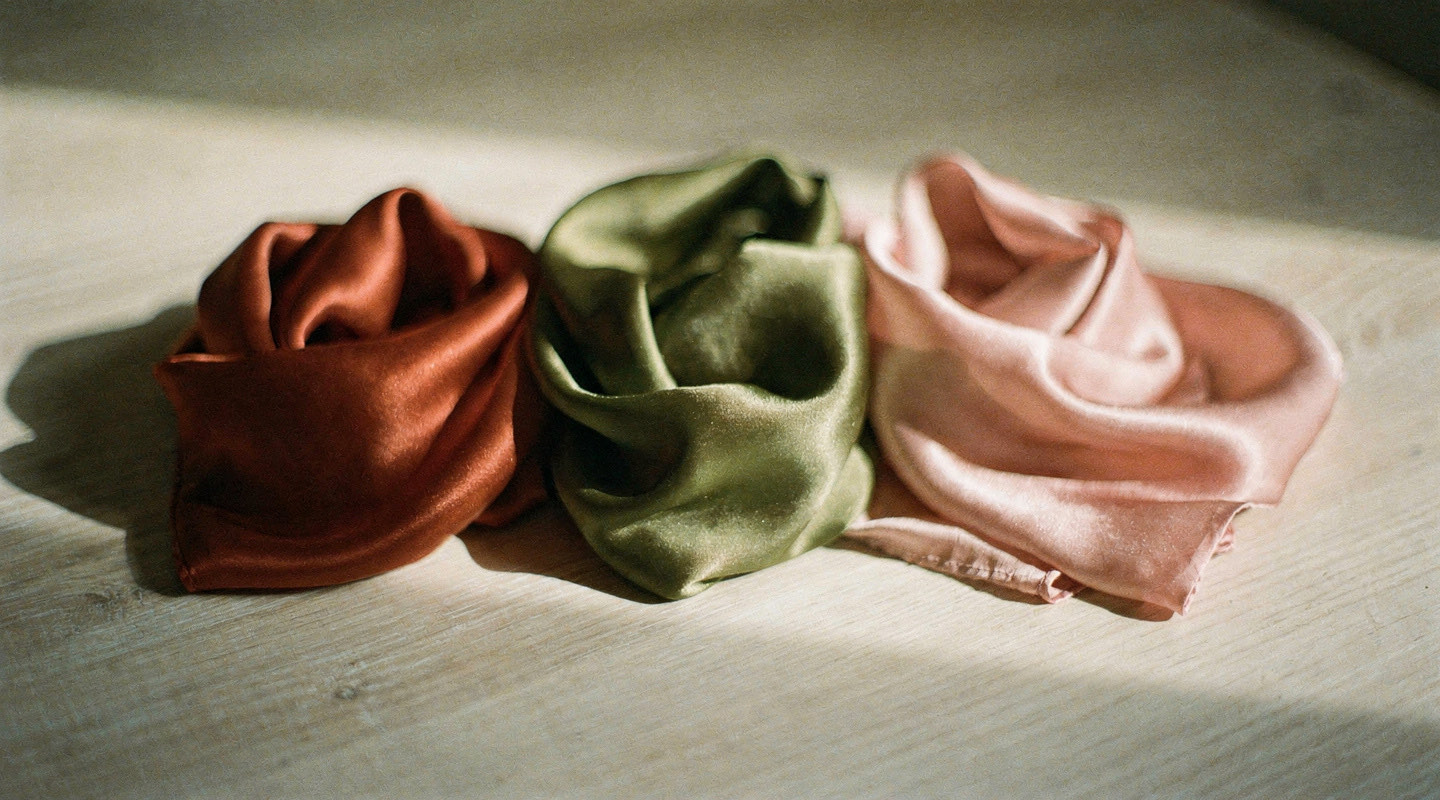
Almost everyone owns one. A silk square, inherited or bought on a good day, folded in a drawer because it seems like it needs an occasion.
It does not. A silk scarf is the most flexible accessory you can own, and the only thing standing between the drawer and daily use is knowing four or five ways to tie it. Late summer is the moment it earns its keep, since it adds something at the neck without adding any warmth you do not want yet.
Start With the Fold
Nearly every method below begins the same way, so it is worth getting this right once.
Lay the square flat and fold it corner to corner into a triangle. Then fold the long edge up toward the point in bands, three or four centimeters at a time, until you have a long strip. This is called the bias fold, and it is the base for most neck knots.
Keep the folds a little loose. Silk that has been pressed into a hard flat band looks stiff and sits badly. You want it soft enough to have some body.
A quick word on size, since it changes what is possible. A small square around 50 cm is a neck and hair scarf. A large square around 90 cm can do everything, including working as a shawl. If you are buying one to start with, the larger size is more useful.
1. The Classic Loop
The one to learn first, because it works with almost anything.
Drape the folded band around your neck with one end noticeably longer than the other. Take the long end, wrap it once around your neck, and let both ends fall roughly even at the front. Loosen the wrapped section slightly with your fingers so it has some volume.
It sits well over a crew neck, under a collar, or over a light jacket, and it takes about four seconds once you have done it twice.
2. The French Knot
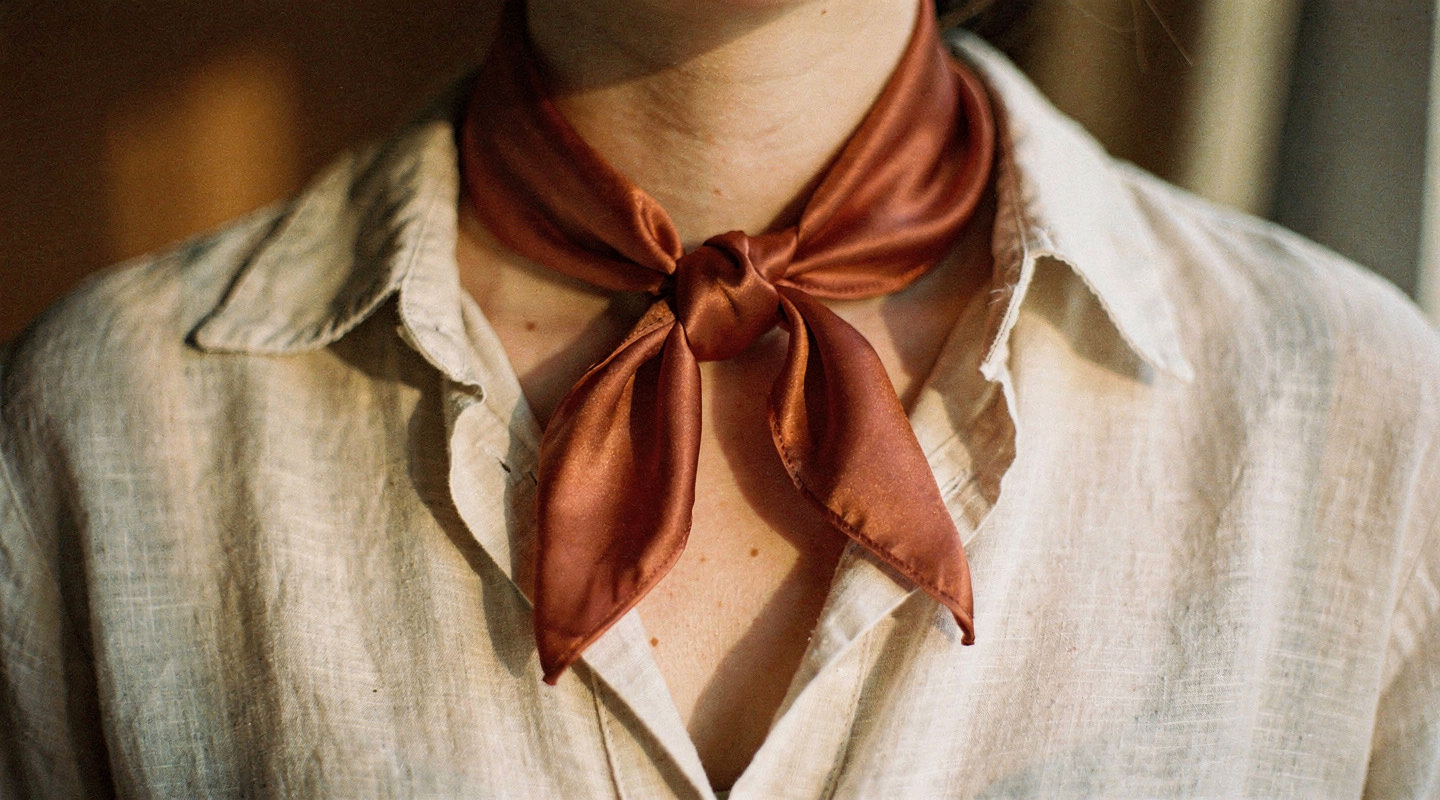
Slightly more polished, and the one that looks deliberate with a structured coat or a silk blouse.
Fold the band in half so it makes a loop at one end. Place it around your neck, take the two loose ends, and pass them through the loop. Then adjust: pull to tighten toward the throat for something crisp, or leave it slack for something softer.
The whole effect depends on where you stop tightening. High and neat reads formal. Loose and slightly off center reads much better with everyday clothes.
3. The Neckerchief
Skip the long fold for this one. Fold the square into a triangle, place the point at the front of your throat, take the two long ends behind your neck, cross them, and bring them back to the front. Tie a small knot to one side, under the point of the triangle.
This is the one that suits an open collar or a plain t-shirt, and it is the most forgiving with a patterned scarf, because the triangle gives the print room to actually be seen.
4. The Knotted Double Loop
For a bigger scarf and a cooler day. Wrap the folded band around your neck twice, then tie the ends in a loose double knot at the front or slightly to the side.
Two wraps gives you volume and a bit of real warmth, which makes this the knot that carries a silk scarf into autumn rather than leaving it behind in August.
5. The Headband
Fold the scarf into a narrow band. Lay it against the back of your head, bring the ends up and forward, and tie them at the top or just off to one side. Tuck the tails under, or leave them showing.
It works with loose waves, with a bun, and particularly well on a day when your hair has its own plans. A silk band also does not crease or pull hair the way a hard band does.
6. Around a Ponytail
The smallest use and the one that gets the most mileage.
Fold a small scarf into a thin strip and tie it around the base of a ponytail or bun, over the elastic. One wrap and a knot, or two wraps and a bow, with the ends left to hang.
It hides the elastic, adds a colour, and takes no thought at all. This is the trick that turns a scarf from an occasion item into something you use on a Tuesday.
7. On a Handbag Strap
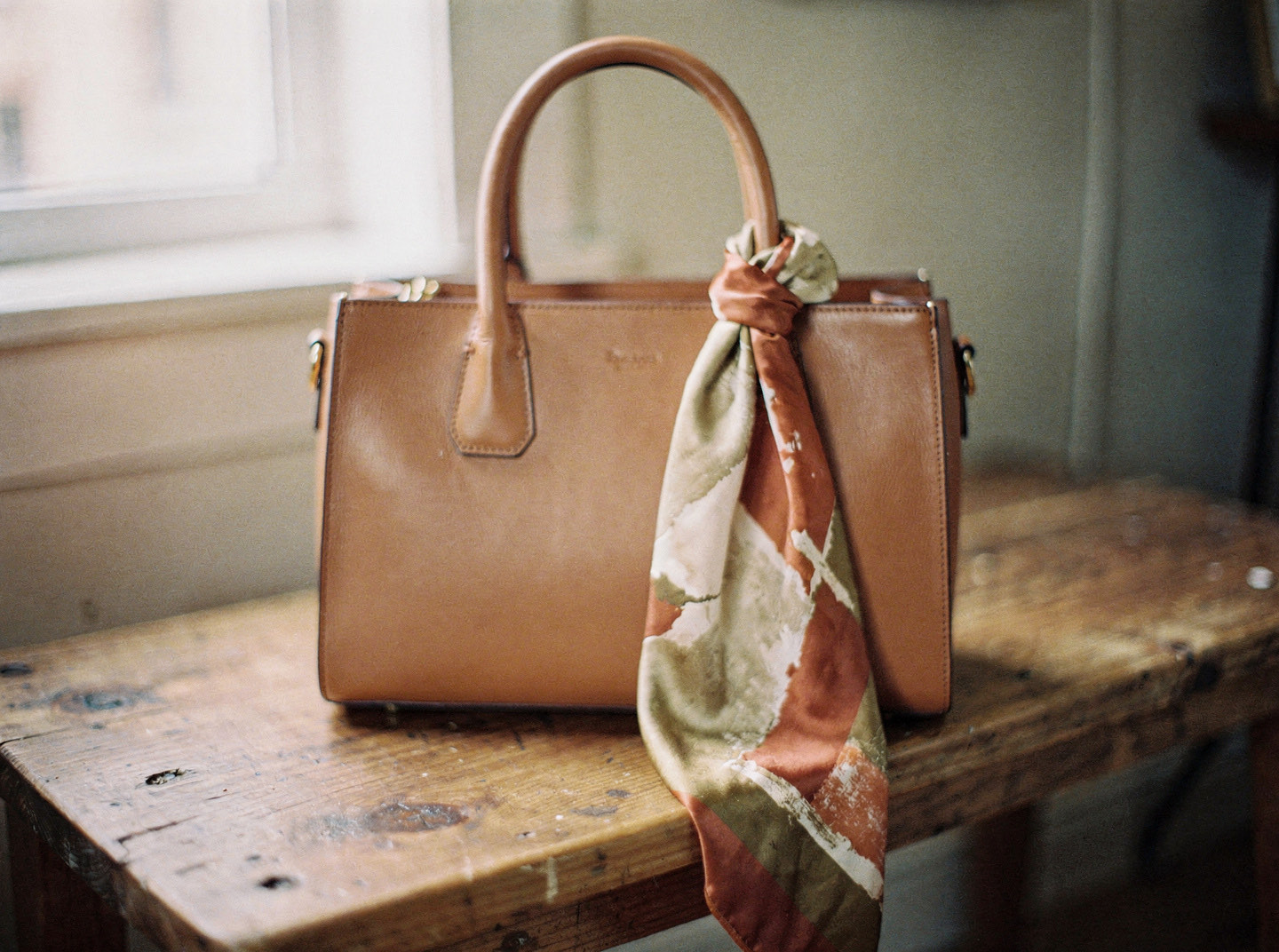
Wrap a small or medium scarf tightly around the base of a bag handle and knot it, letting the ends trail. Or wind it along the whole handle for a fully wrapped look.
There is a practical reason as well as a decorative one. The scarf takes the wear that would otherwise go into the leather at the point where your hand sits. It softens a plain bag, breaks up a very structured one, and it is the easiest way to bring a colour into an otherwise neutral outfit.
Choosing and Caring for One
Colour first: a scarf sits directly under your face, so pick shades you already know suit you rather than whatever is on trend. Prints with some empty ground read better than dense allover patterns, because folding a busy print turns it into noise.
For late summer moving into autumn, the palette doing the most work is rust, amber, olive, and chocolate brown, which sit comfortably against the linen and cotton still in rotation. A scarf is also a sensible way to test a colour before committing to a coat in it.
On care, silk is more robust than people expect and less tolerant of two specific things: perfume and sunlight. Spray scent before the scarf goes on, never after, and store it folded in a drawer rather than hanging in a bright room, since sustained light fades dye faster than wearing it ever will. Hand wash cool with a gentle detergent, roll in a towel, and dry flat away from direct heat.
If you are building out the rest of the look, the accessories that complete a summer outfit covers what else earns a place, and a scarf sits happily alongside a layered set of chains and bangles as long as one of the two is doing the talking rather than both. For a quieter wardrobe, the restraint of normcore is exactly the setting where one good scarf does the most work.
Take it out of the drawer. That is genuinely the hardest step.