
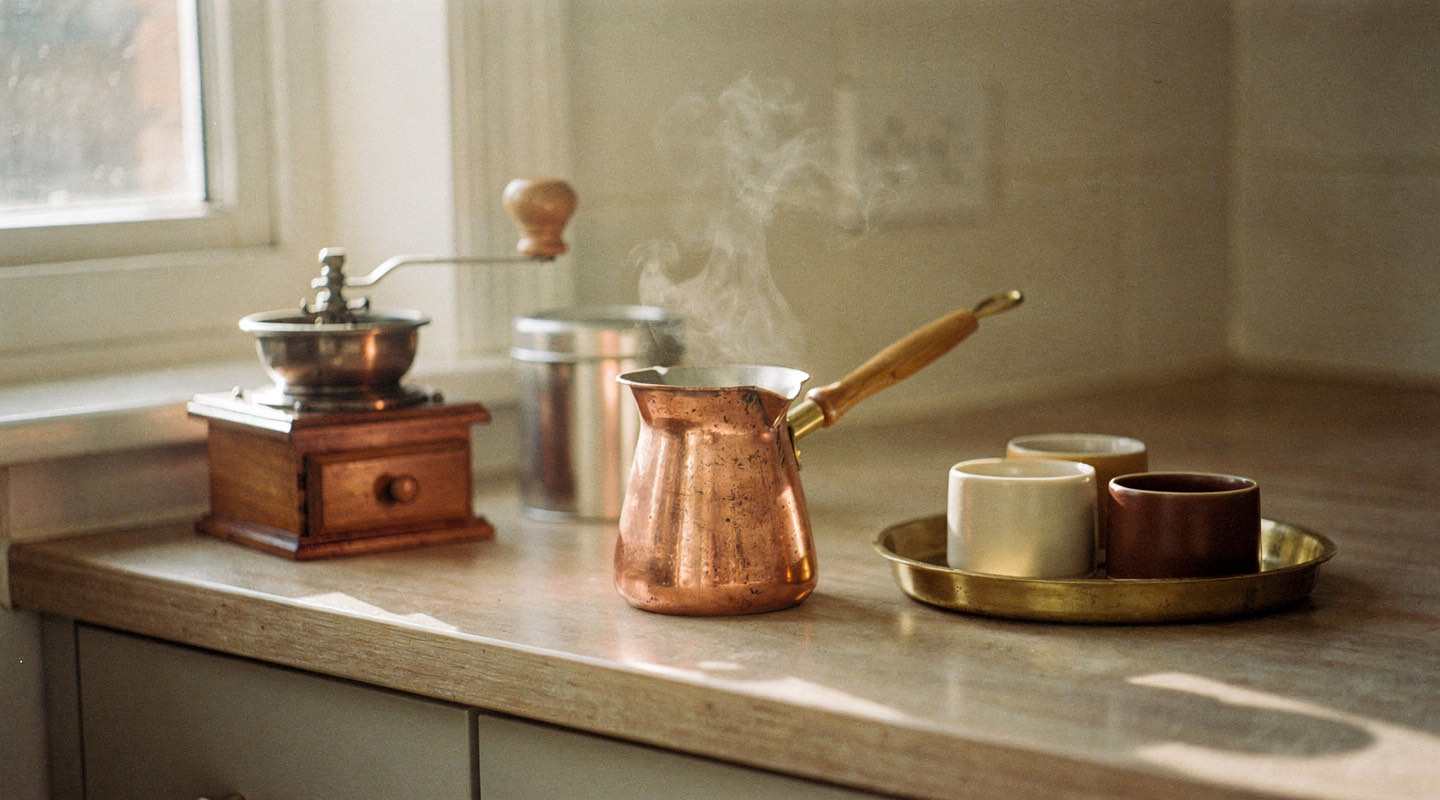
A coffee ritual survives or dies on how many steps it takes. If the cezve lives at the back of a cupboard behind the mixing bowls, you will make Turkish coffee on Sundays and not often. If everything sits together on a tray within arm’s reach of the stove, you will make it most days.
That is the entire argument for a coffee corner, and it is a practical one rather than a decorative one. Here is what actually goes in it, what you can skip, and how to arrange it so it stays used.
Start With the Cezve
Everything else is optional. This is not.
Buy for the number of cups you usually make, not the number you might one day make. A cezve should be filled no more than two thirds, so a pot sized for two is wrong for one person and a pot sized for six is wrong for almost everybody. Around 250 ml suits two cups comfortably.
Copper with a tin lining is traditional and it is traditional for a reason: copper conducts heat quickly and evenly, which is exactly what a slow brew needs. Thick brass and good stainless both work. What you want to check is the shape, a narrow neck flaring to a wider base, because the narrowing is what concentrates the foam. A straight-sided pot will not crown properly no matter how careful you are.
Check the handle too. It should be long, and if it is wood or has a wooden grip, better again.
Cups: Small, and More Than You Think
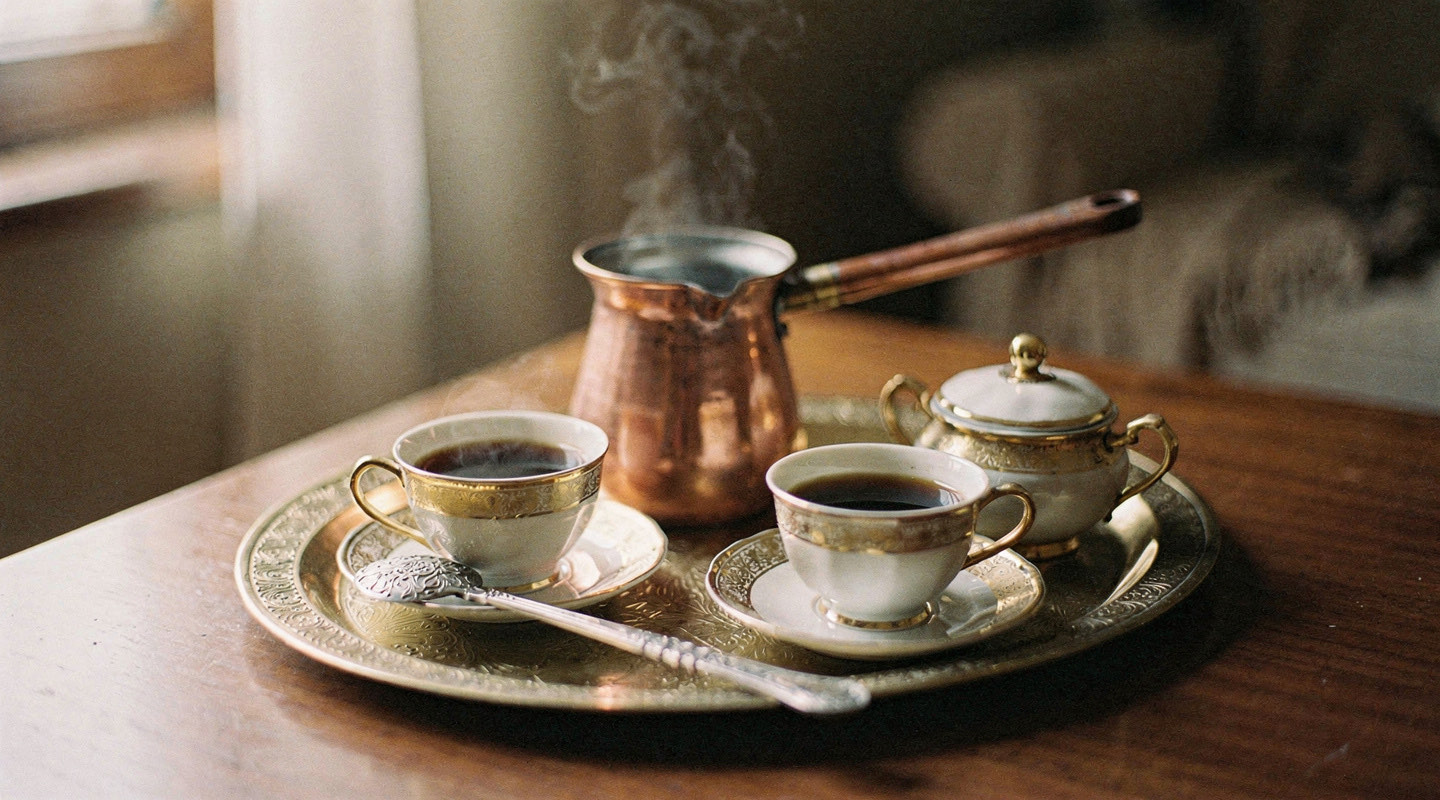
Turkish coffee is served in a fincan, a demitasse cup holding roughly 60 to 90 ml, with a saucer. The small size is not daintiness. A larger cup lets the coffee cool too fast and spreads the foam too thin.
Buy four rather than two. Coffee here is a social drink and the second guest always arrives.
Porcelain holds heat best and is the traditional choice. Plain white interiors have a practical advantage worth mentioning: if anyone in your house reads cups, a patterned inside makes the grounds impossible to see. That alone is a good reason to keep at least two plain-lined cups in the cupboard.
Filigree metal holders over small cups are the ornate Ottoman-style option, and they are lovely. They also add a step to washing up, which matters more than it sounds for something you want to use daily.
The Tray Is the Actual Trick
The tray is what turns a collection of objects into a corner.
Everything lives on it: cezve, cups, sugar bowl, spoons, and a small dish for lokum. When you make coffee, the tray comes to the table with you. When you serve someone, you serve from it. When you are done, everything goes back in one movement instead of five.
Copper and brass are traditional and they patinate beautifully. A plain wooden tray works just as well and costs a fraction as much. What matters is that it has a lip, so nothing slides, and that it is big enough to hold the whole set with a little room, but small enough to carry in one hand.
What Else Earns Its Place
A short list, because a corner that accumulates stops being a corner.
- A long-handled spoon for the single stir at the start.
- A small sugar bowl. Sugar goes in the pot before brewing, never into the cup afterward, so it needs to be at the stove rather than at the table.
- Water glasses. Water is served alongside and drunk first, to clear the palate.
- A small dish for lokum or a square of dark chocolate.
- An airtight coffee tin, kept out of the light and away from the heat of the stove.
And one thing that changes everything if you have room for it: a grinder that goes fine enough. Turkish grind is finer than espresso, closer to powdered sugar, and pre-ground coffee starts losing what makes it foam almost immediately. A hand mill takes a couple of minutes of effort and is the single biggest quality jump available, since stale or too-coarse coffee is one of the main reasons a cup comes out flat.
Where to Put It
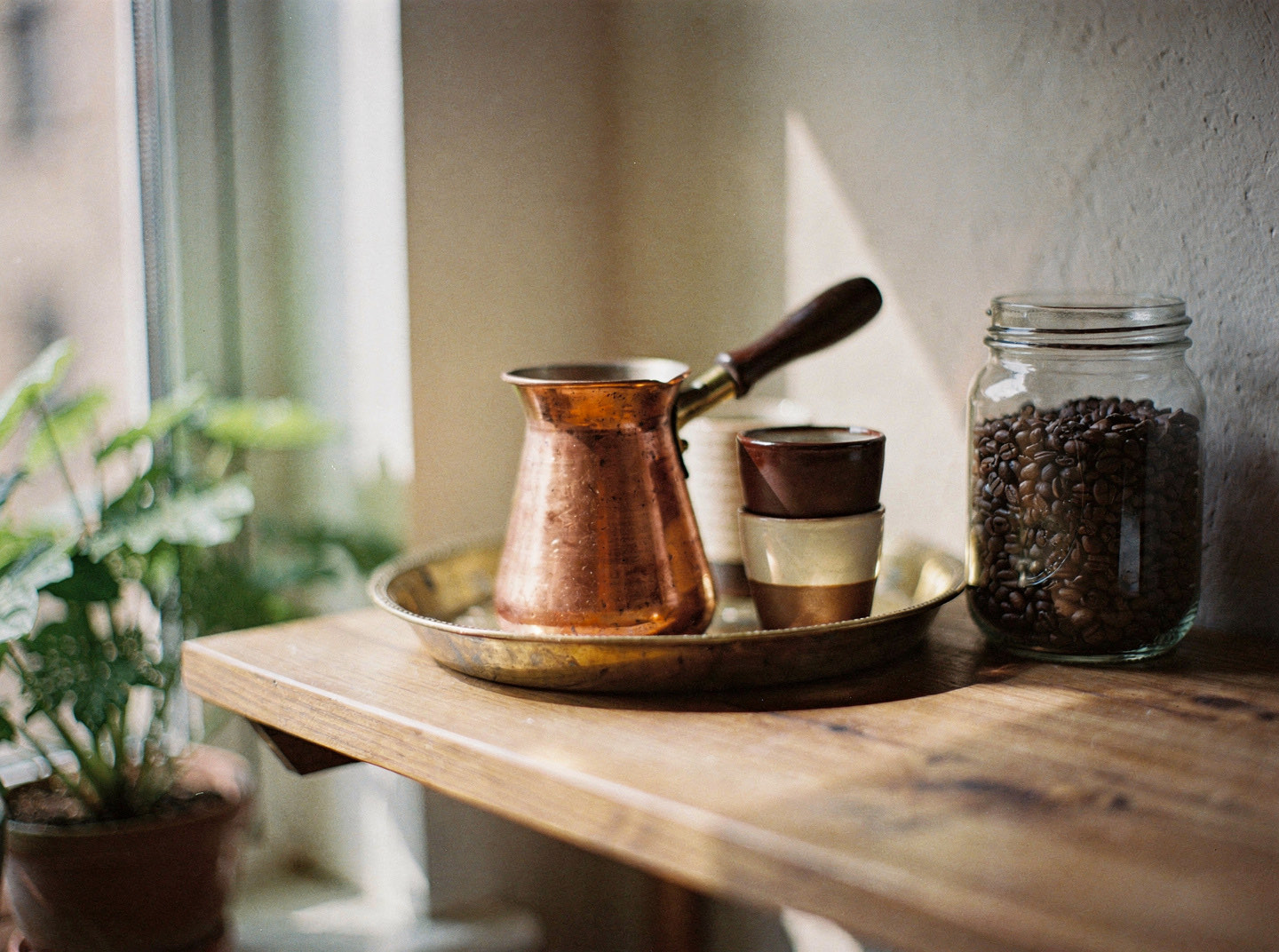
Within one step of the stove. That is the whole rule, and it beats every aesthetic consideration.
An open shelf near the hob, the end of a counter, or a small side table if your kitchen has one. Not a high cupboard, not behind a door, not in the dining room away from the heat. The distance between where the pot lives and where it gets used is the thing that quietly decides whether this becomes a habit.
Leave a little empty space around it. The corner reads as considered when the objects have room, and cluttered when they do not, which is the same principle that makes arranging a room to suit yourself work at any scale.
Light helps. A window nearby makes copper look like copper, and it also means the corner is somewhere you will want to stand for four minutes while the pot comes up.
Using It Is the Point
A coffee corner that becomes an ornament has failed. Copper wants to be handled, and the patina it develops from use is much better looking than the one it develops from sitting.
So make coffee in it on ordinary days, not only when someone visits. Keep it stocked. Wash the cezve by hand and dry it properly, since sitting wet is what damages the lining. Let the tray get a few marks.
If you want the full ritual to go with the setup, how to serve and drink it properly covers the etiquette, and the classical cezve method covers the brew itself. There are also more uses for the grounds afterward than most people realize, which is a satisfying way to close the loop.
Four minutes, twice a day, in the same small corner. That is a good habit to build a kitchen around.