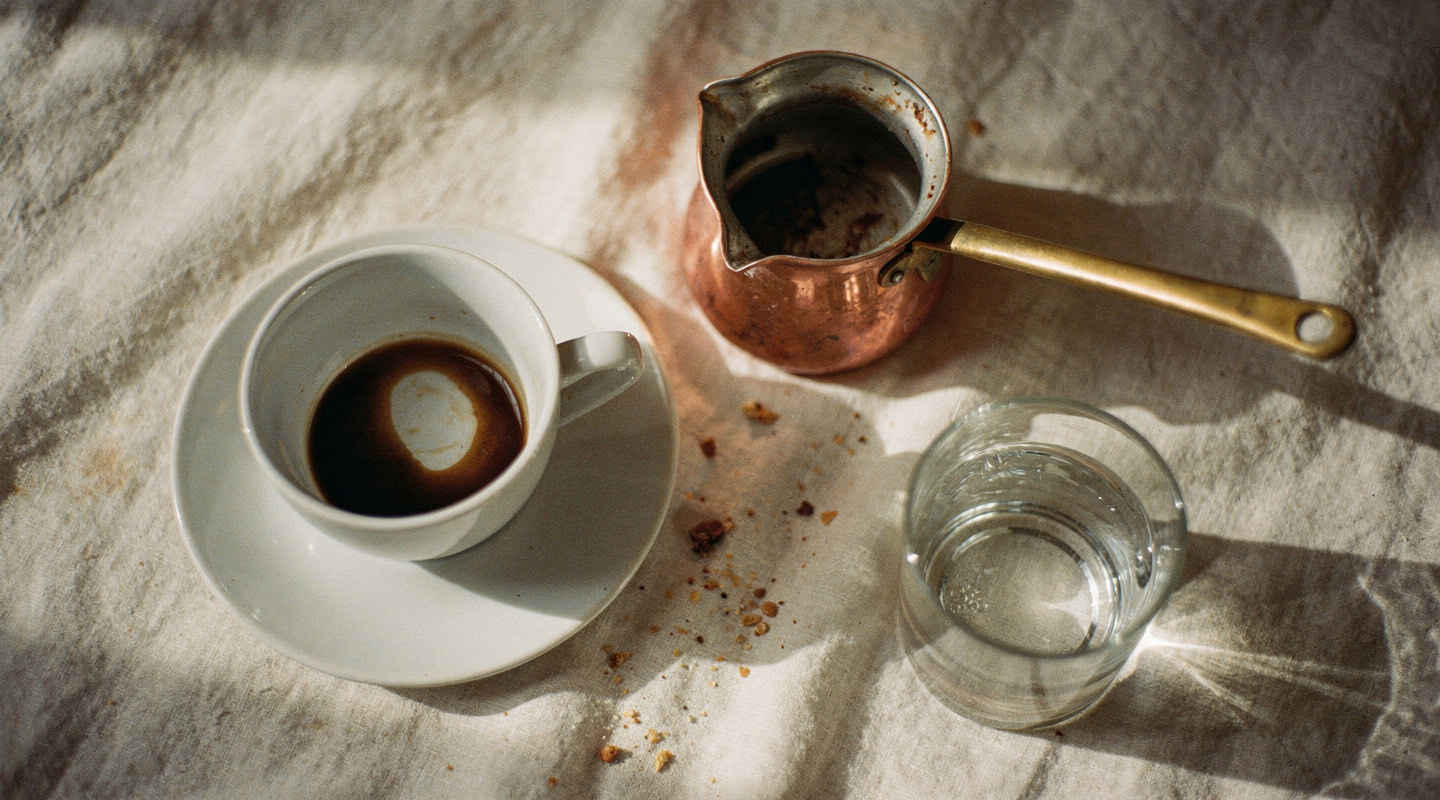
Almost everything written about coffee reading is about symbols. What a bird means, what a fish means, what to make of a long line running toward the rim.
Very little is written about the part that actually carries the tradition: the customs around the cup. Who turns it, who reads it, what gets said before the saucer goes on, and why someone puts a coin on the base. These are not decoration. They are the structure that makes the whole thing work socially, and they are the difference between a warm half hour and an awkward one.
You Do Not Read Your Own Cup
This is the firmest rule in the tradition, and it is a good one.
In Turkey, reading your own cup is considered both biased and, frankly, no fun. The reading is something one person gives another. The reader looks, interprets, and offers; the drinker listens, recognizes, or disagrees. Take one of those roles away and there is nothing left but a person staring into porcelain confirming what they already hoped.
The custom protects something real. Half the value of a reading is that it comes from outside you. Someone else noticing a shape and saying “this looks like a door to me” gets you to respond honestly in a way that your own interpretation never will.
Turning the Cup
The sequence is settled and worth following, because every step has a practical reason underneath the ceremony.
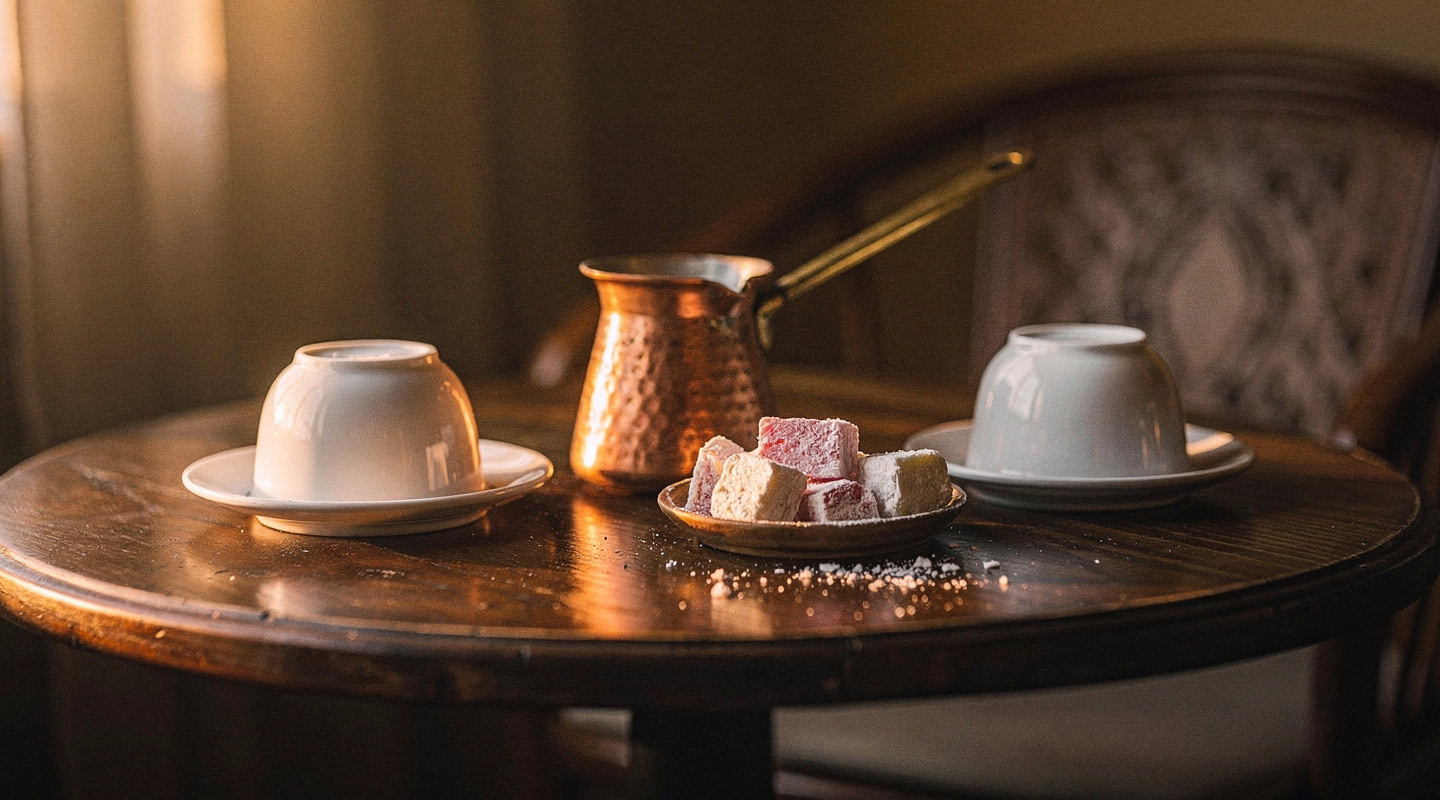
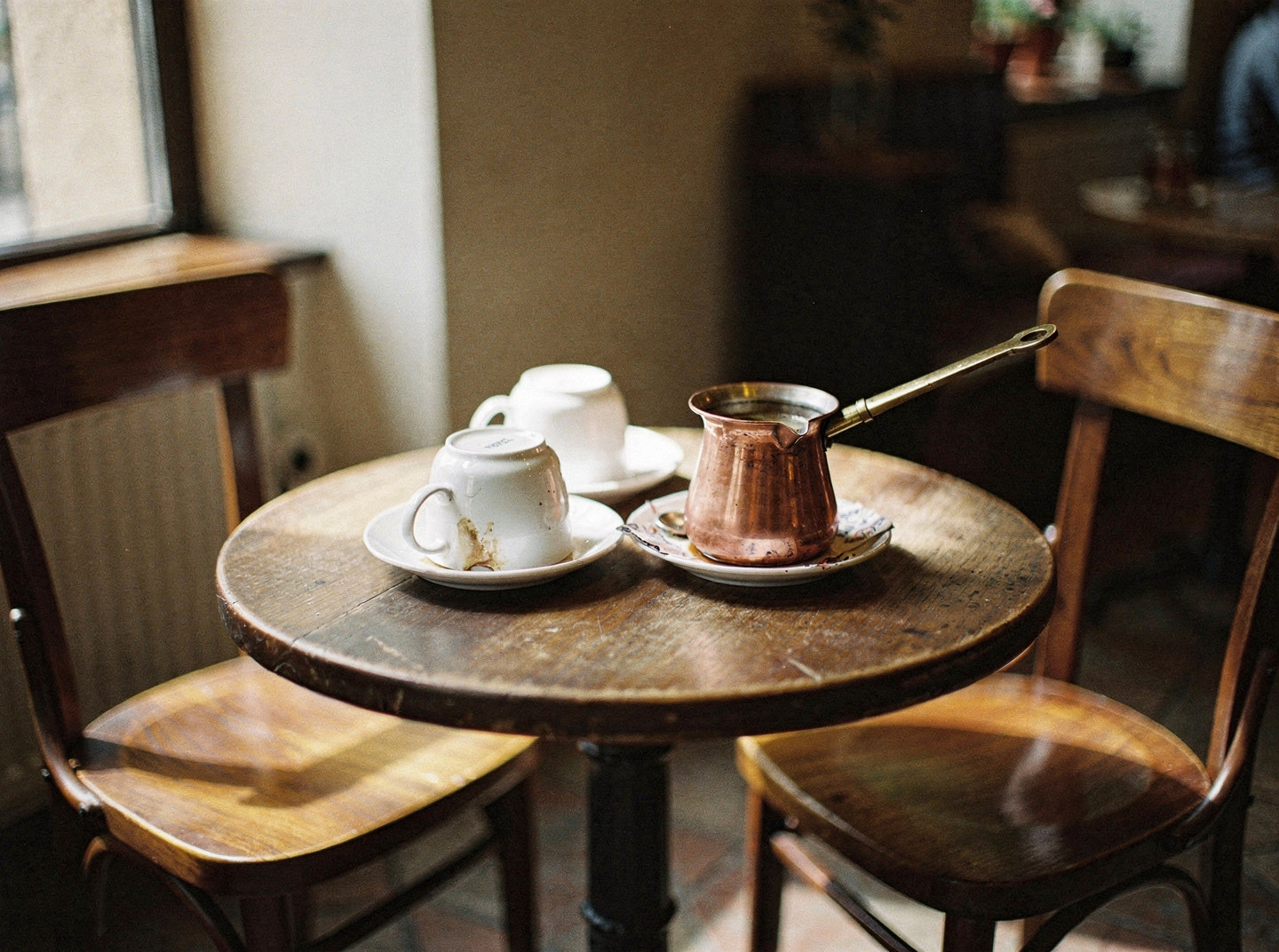
The drinker finishes the coffee, leaving the sediment. A saucer goes over the cup, and the drinker turns the whole thing over away from themselves, in one motion, then sets it down and leaves it.
Many people say something as they turn it. The traditional line translates roughly as “let my fortune match my state,” which is a modest sort of wish: not for good news, but for a reading that fits the life.
Then it has to cool completely. Ten minutes at least, often longer. Lifting the cup early is the single most common mistake, because the reading lives in the dried tracks the grounds leave running down the sides, and while they are wet there is nothing to see.
The Coin on the Base

While the cup cools, a coin is often placed on the upturned base.
The stated purpose is to keep any bad reading from settling, to press it down and hold it away. Some households use a ring instead when the question is about love, which tells you how flexible the custom is.
You can take this literally or not. What it does regardless is set an expectation before the reading even begins: that this is meant to be kind, that nobody at this table is here to frighten anybody. A small object placed on a cup is a surprisingly effective way of saying so without saying it.
What a Good Reader Actually Does
The etiquette of the reading itself is mostly about restraint.
A good reader describes before they interpret. “There is a long line running from the handle up toward the rim” comes first; what it might mean comes second. That order lets the person holding the cup see it too, and it keeps the reading collaborative rather than delivered.
They also leave room. Traditional readings are full of hedged, open phrasing, and this is not vagueness for its own sake. It is an invitation for the drinker to fill in the specifics, which they almost always do, and what they volunteer is usually the actual subject of the conversation.
And they stop. A reading that goes on for twenty minutes has stopped being about the cup. Three or four things noticed properly is a full reading.
The Things Not to Say
This is where etiquette earns its keep, because a careless reading can genuinely upset someone.
Nothing about death, illness, or the health of a specific person. Nothing that names a third party as untrustworthy. No dates, no numbers presented as certainties, no “this will happen by October.” A reader who deals in specifics like these is not practising a tradition, they are making claims they cannot support, and someone may act on them.
The heavier symbols get softened by convention rather than reported flatly. A cross is a burden or a decision, not a catastrophe. A snake is a suggestion to be careful, not an accusation. The tradition has always had this instinct built in, and it is the reason it survived as something people do at kitchen tables rather than something people fear.
If a cup genuinely looks unpromising, the customary move is to note it lightly and move on. Nobody is obliged to report everything they see.
Being the One Whose Cup It Is
There is etiquette on the receiving side too, and it is simpler.
Do not interrogate the reader. Do not ask for a date. Do not demand a yes or a no, since the tradition does not deal in those and pressing for one only encourages the reader to invent.
Do say when something lands, and equally, do say when it does not. “That does not sound like me” is a perfectly good response and it keeps the whole thing honest.
And afterward, let it be a conversation rather than a verdict. The cup has done its job the moment it gets two people talking about something neither of them would have raised directly.
Why the Customs Matter
Strip out the etiquette and coffee reading becomes fortune telling in the worst sense: one person making confident claims about another person’s future.
Keep the etiquette and it is something else entirely. A ritual with a built-in pause, a reason to sit down together, a form of attention offered as a small gift, and a set of conventions specifically designed to keep it gentle. That is why it has lasted for centuries at ordinary tables, and it is why it should be treated as culture and company rather than prophecy.
If you want the mechanics that go under all of this, where a symbol sits in the cup covers the geography and what the individual shapes traditionally mean covers the vocabulary. None of it works without a proper cup underneath, so the classical cezve method is the real starting point, ideally made in a corner set up for it.
Make coffee for someone this week and turn the cup over. The rest takes care of itself.