
Most symbols in a coffee cup take a little imagination. A bird might be a smudge with wings. A tree might be a tree, or a crack, or nothing at all. But every so often you turn over your cup and find something that looks startlingly deliberate: a clear letter M on the wall, or a tidy number 3 near the handle.
Letters and numbers have a special place in cup reading because they feel so specific. That is also why they deserve the most care. So how are letters and numbers traditionally read in a coffee cup, and how much weight should they carry? Let’s look closely.
How Do You Spot a Letter in the Cup?
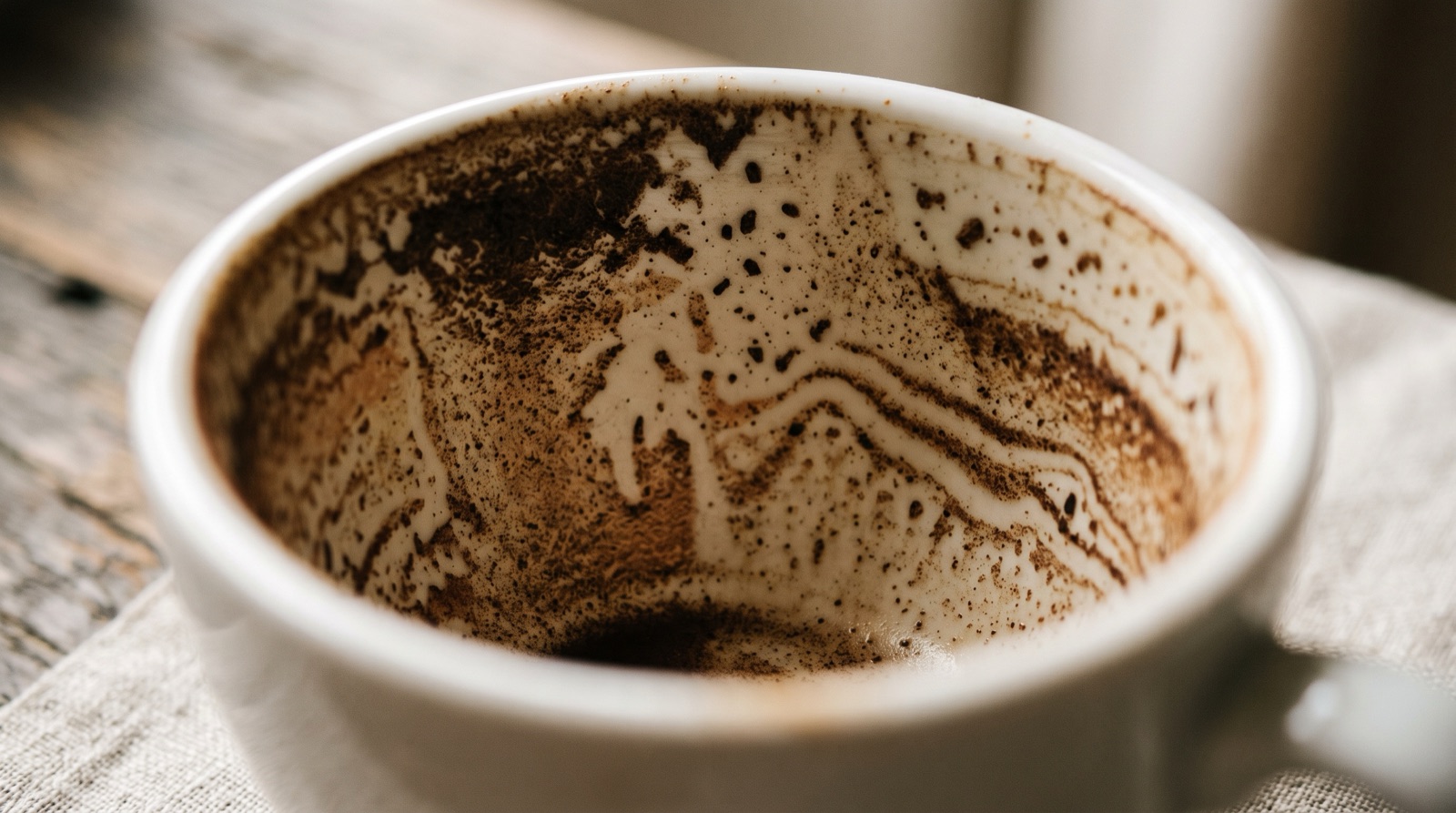
Letters tend to appear in two ways. Some are formed by a single run of grounds, a line that bends into an L or a curve that closes into an O. Others are built from several small marks that sit together, the way a V might appear where two streaks meet.
The traditional advice is to look at the cup as a whole before hunting for letters. A shape that only becomes a letter after you tilt your head, squint, and fill in a missing stroke is probably better read as something else. Clear letters announce themselves. You notice them before you go looking.
It also helps to remember who is looking. A letter seen upside down from across the table may be a different letter, or no letter at all, from where the cup’s owner sits. Readers orient the cup by its handle, which brings us to position, but first, the letters themselves.
What Letters Traditionally Mean
The most common way to read a letter is as an initial. A letter in the cup is taken to point to a person or a place whose name begins with it: a friend, a relative, a city, a workplace. The reader does not decide who it is. The person whose cup it is usually recognizes the initial at once, and that flash of recognition is part of the reading.
The idea is old and widespread. An old tea leaf reading handbook, published anonymously by “a Highland Seer” and old enough to mention telegrams, notes that stray leaves often form letters of the alphabet and reads them as initials: an L beside the small square shape of a posted letter means news from someone whose surname begins with L. It is the same instinct behind the old Halloween game of tossing an apple peel over your shoulder to see whose initial it forms, which we described in our look at Halloween divination customs.
Some readers also give individual letters meanings of their own, and our original guide to Turkish coffee fortune-telling and the symbols in the cup lists a few. These lists differ from reader to reader and family to family. There is no single authorized alphabet, and it is worth being honest about that.
What Numbers Traditionally Mean
Numbers are usually read as time or quantity. A number may stand for days, weeks, or months, or for how many of something: people, visits, opportunities. The symbol beside the number decides which. A 3 next to a road might be read as a journey in three weeks, while a 3 next to a group of small figures might be three new faces in your circle.
The Highland Seer handbook makes the same point plainly, saying that numbers depend on the symbols they appear with. Its own example is a numeral 4 beside the sign of a parcel, read as a parcel arriving in four days. A number floating alone, with nothing around it, is the hardest kind to read, and many readers simply note it and move on.
Notice how this works. The number never carries the story by itself. It adds detail to a symbol that is already there, which is why experienced readers rarely build a whole reading around a single numeral.
Why Position Changes Everything
As with every symbol, where a letter or number sits shapes how it is read. In the traditional geography of the cup, the handle represents the drinker. Letters close to the handle point to people close to you, while those on the far side point to people further away, in distance or in relationship.
Height in the cup is read as timing. Marks near the rim are taken as nearer in time, and marks toward the bottom as further off. So an initial near the rim and close to the handle suggests someone already near and already on your mind, while the same initial low on the far wall belongs to someone you may not have met yet.
If the handle and the rim are new to you, our guide to reading the coffee cup and where the symbol sits explains the whole map.
Reading Letters and Numbers With Care
Letters and numbers are the most tempting symbols to over-read, because they look like answers. Resist that. A letter is an invitation to think about someone, not a verdict about them. A number is a detail that colors a symbol, not a deadline.
This is one reason thoughtful readers never present dates or numbers as certainties, a principle we wrote about in our guide to coffee reading etiquette. Nobody should leave a reading believing something will happen on a particular day because of a mark in the grounds.
Read lightly, share what you see with warmth, and let the person whose cup it is fill in the meaning. That is where the real conversation of a coffee reading happens.
The next time you turn your cup and find an initial looking back at you, smile, think of whoever it brings to mind, and perhaps send them a message. That alone is a lovely thing for a coffee cup to do. We wish you a pleasant reading!