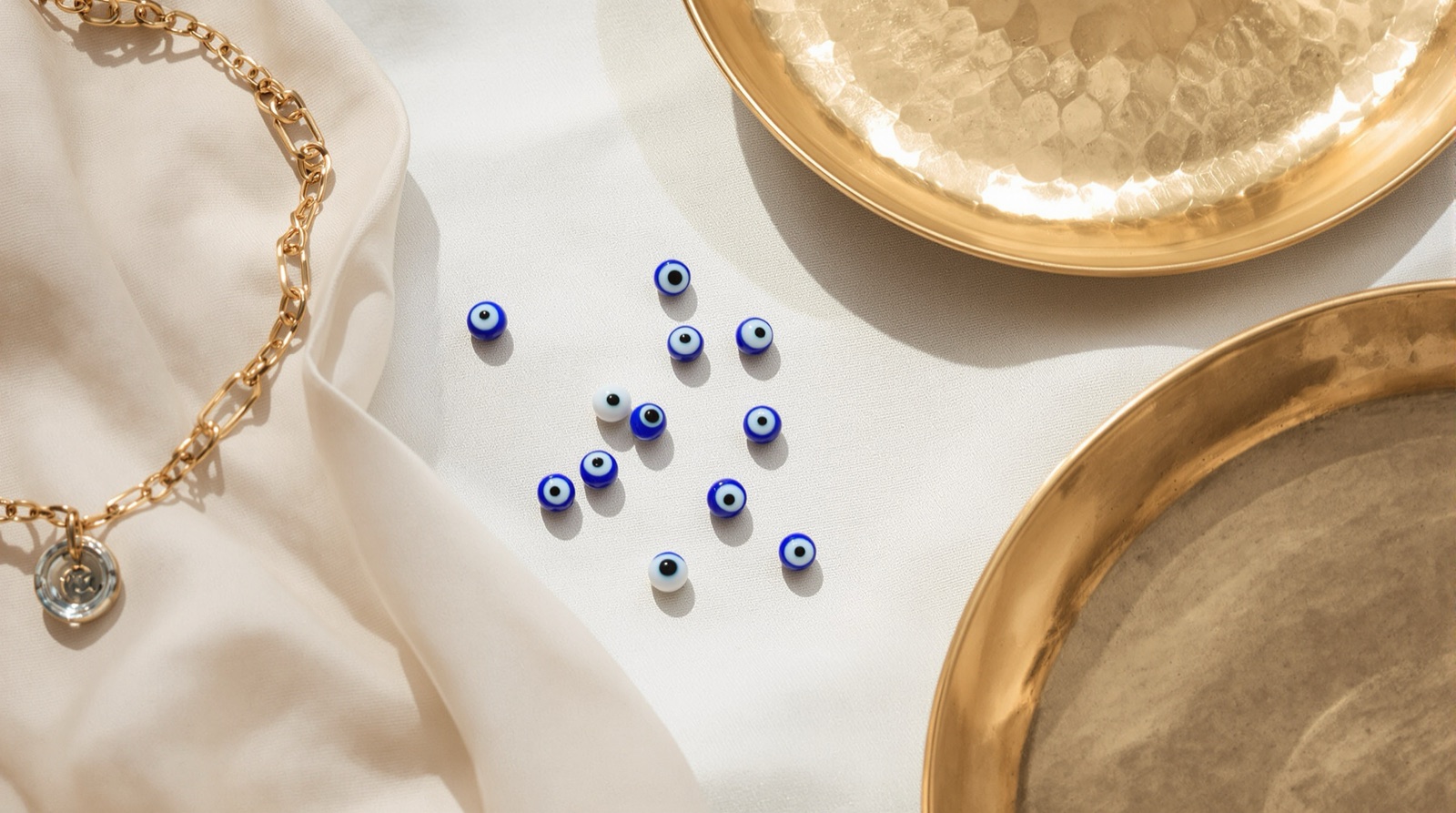
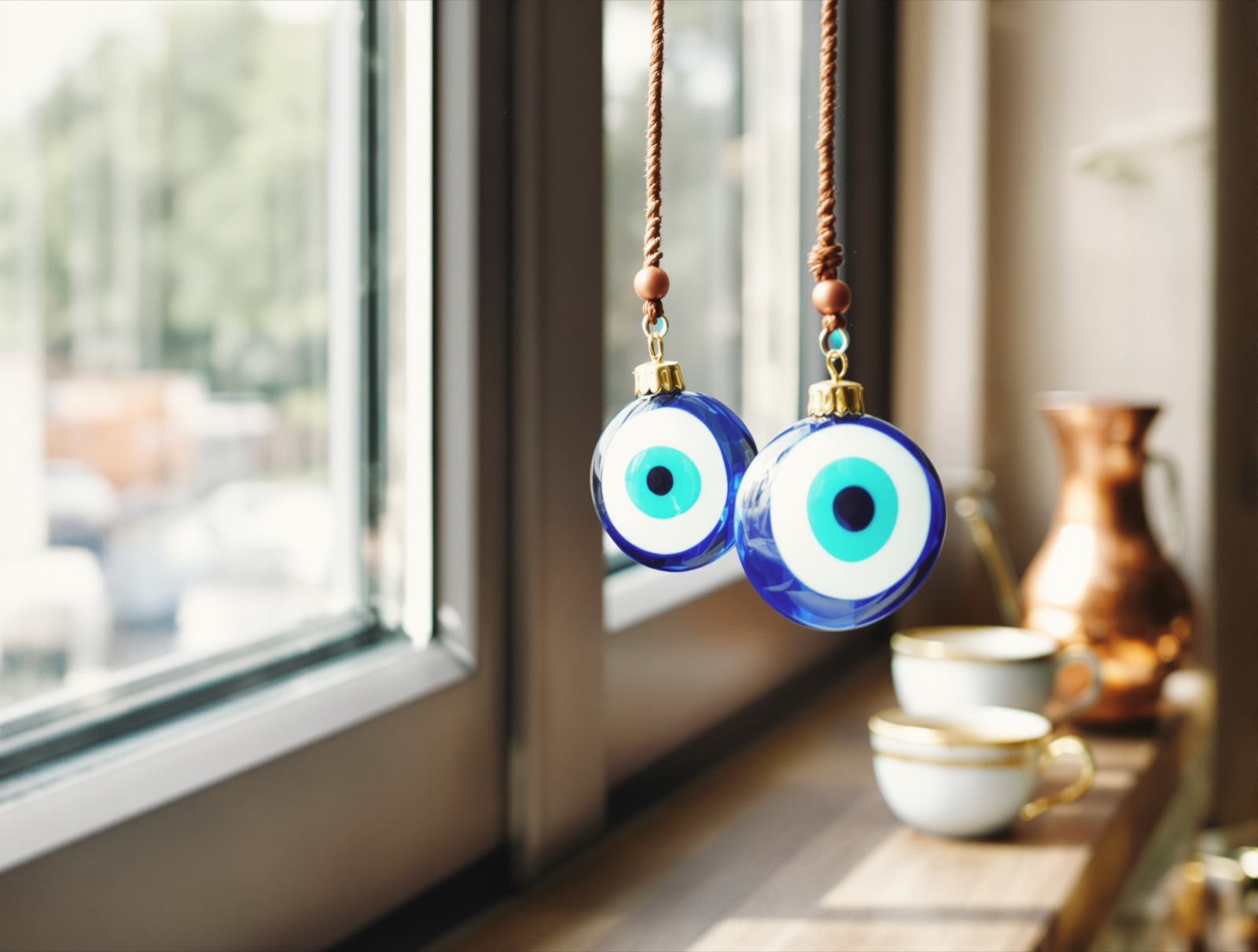
You have almost certainly seen one. A small disc of deep blue glass with a white ring, a lighter blue circle, and a dark dot at its center, hanging from a wrist, a rear-view mirror, or a nail above a front door. In Turkey it is called the nazar boncuğu, and it is so woven into daily life that most people stop noticing it. You tend to see it again only when you travel somewhere it isn’t.
Lately it has traveled everywhere. Jewelers report that shoppers are choosing pieces for what they mean rather than only for how they look, and the evil eye sits right at the heart of that shift. So what is the meaning behind evil eye jewelry, where did it come from, and how do you wear one well?
What Does the Evil Eye Actually Mean?
The word nazar comes from Arabic, and it simply means a look, a glance, or sight. The belief attached to it is that a gaze carrying envy, even unintentionally or admiringly, can bring misfortune to whatever it lands on. A new baby, a new home, a run of good luck: anything that invites admiration is thought to be exposed.
The charm is the countermeasure. It is not a wish for good fortune so much as a shield for fortune you already have. The eye looks back at the world, and by looking, it absorbs and deflects. That distinction is the whole character of the object, and it explains why nazar beads are so often placed where good things are: over a cradle, at the entrance of a new shop, on the wrist of someone starting something.
It is worth saying plainly that this is folklore, not physics. What makes the nazar lovely is what it says about the people who hang it: they have something worth protecting, and they know it.
Why Blue?
One common explanation is that in the Mediterranean and the Middle East, where dark eyes are the norm, blue eyes were unusual enough to be considered striking, and a striking gaze was the one most likely to carry weight. Whether or not that is the true origin, the color stuck. Blue glass is also simply what the region’s glassmakers could produce beautifully, using copper and cobalt in the melt.
The classic bead layers four colors outward from the center: dark pupil, pale blue iris, white, then deep blue. That layering is what separates an authentic glass nazar from a printed sticker version.
An Old, Slightly Uncertain History
Eye-shaped protective amulets are genuinely ancient. The alabaster “eye idols” excavated at Tell Brak in modern-day Syria, dating to roughly 3300 BCE, are often cited as the earliest ancestors of the evil eye. Scholars are rather more cautious. The theologian John H. Elliott, among others, has argued these figures are more plausibly connected to the worship of the goddess Ninhursag than to the evil eye specifically.
What is clearer is that belief in the harmful gaze is documented across the ancient Greek, Roman, Egyptian, and Anatolian worlds, and that once glassmaking spread from Mesopotamia and Egypt into Anatolia, artisans there began giving the idea the blue glass form we recognize today.
If you enjoy tracing a tradition back through the region like this, you will find the same long thread running through the history of Turkish coffee, another everyday object that turns out to carry centuries.
How a Nazar Bead Is Actually Made

The modern Turkish craft has a surprisingly recent and specific origin. Around the First World War, Egyptian bead masters arrived in İzmir and set up workshops in the Kemeraltı district. Turkish artisans learned the technique from them and adapted it. At first they made plain blue beads to decorate horses and mules, and only later added the eye motif that made the object famous.
Two villages near İzmir became the heart of it: Görece, in the Menderes district, and a village in Kemalpaşa once called Kurudere, where the first kiln opened in 1942. It renamed itself Nazarköy, or “evil eye village,” in 2009, which tells you how completely the craft had become its identity.
The work itself is fast and hot. Artisans stand at furnaces running around 1,200°C, gathering molten glass on a rod and laying down each layer of color by hand in the few seconds before the glass stiffens. No two beads come out identical, and the small irregularities are the point. They are the evidence of a hand.
Choosing a Piece You Will Actually Wear
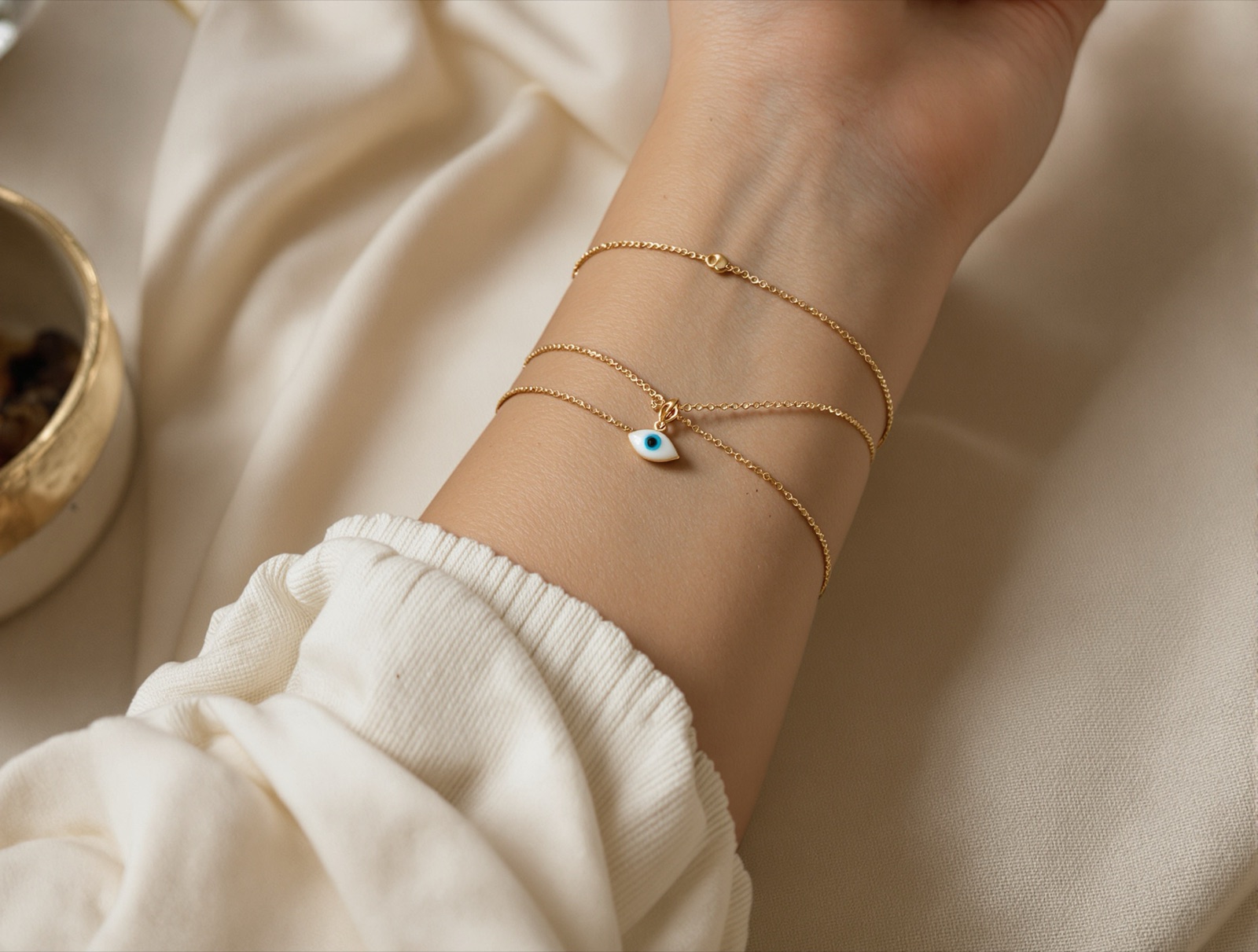
Evil eye jewelry ranges from a two-lira glass bead on a red thread to fine gold set with sapphire and mother-of-pearl. Neither is more correct than the other. What changes is how the piece reads.
- Bracelets are the most worn, and the most casual. A single charm on a fine chain disappears under a sleeve; a strand of small glass beads is more visible and more traditional.
- Necklaces put the eye at the center of an outfit. A small pendant on a short chain works as the anchor piece in a layered set, the same logic behind the accessories that complete a summer look.
- Rings and earrings are the quietest option, good if you like the symbol but not the attention.
- Home pieces are their own category: a large bead on a cord by a window or door, in the same spirit as decorating with your sign in mind.
If you want a piece with real provenance, look for hand-blown glass with slight variation in the layers, rather than the perfectly uniform molded ones.
How to Wear It, According to Tradition
Tradition is generous here. There are few hard rules, mostly gentle conventions.
Some say a bracelet on the right wrist supports work and material matters, while the left is for creativity and the inner life. Many people simply wear the piece where they will see it, on the theory that a charm you notice is a charm that does its job of reminding you.
The most-repeated belief concerns breakage: if your nazar cracks or shatters, it is said to have taken the hit for you and finished its work. You thank it, and you replace it. It is a kind idea, and a useful one. It turns a small loss into a small piece of reassurance.
Gifting is the other tradition worth knowing. A nazar is very often given rather than bought for oneself, which is why it appears at births, weddings, new homes, and departures.
Living With Your Nazar
Glass is glass, so a little care goes a long way. Keep beads away from perfume and hairspray, which dull the surface over time, and take bracelets off before swimming, since chlorine and salt are hard on both the glass and any plating. Store pieces separately so they do not knock against each other in a drawer.
Beyond that, wear it. A nazar kept in a box is a paperweight; the whole tradition assumes the thing is out in the world, catching light and glances.
And if the symbol draws you in, it sits alongside a much older family of practices for reading meaning into everyday things, from the symbols left in a coffee cup to the lines of the palm. None of them tell you your future. What they offer is a small ritual of attention, and a reason to pause.
May yours keep good watch over you.